

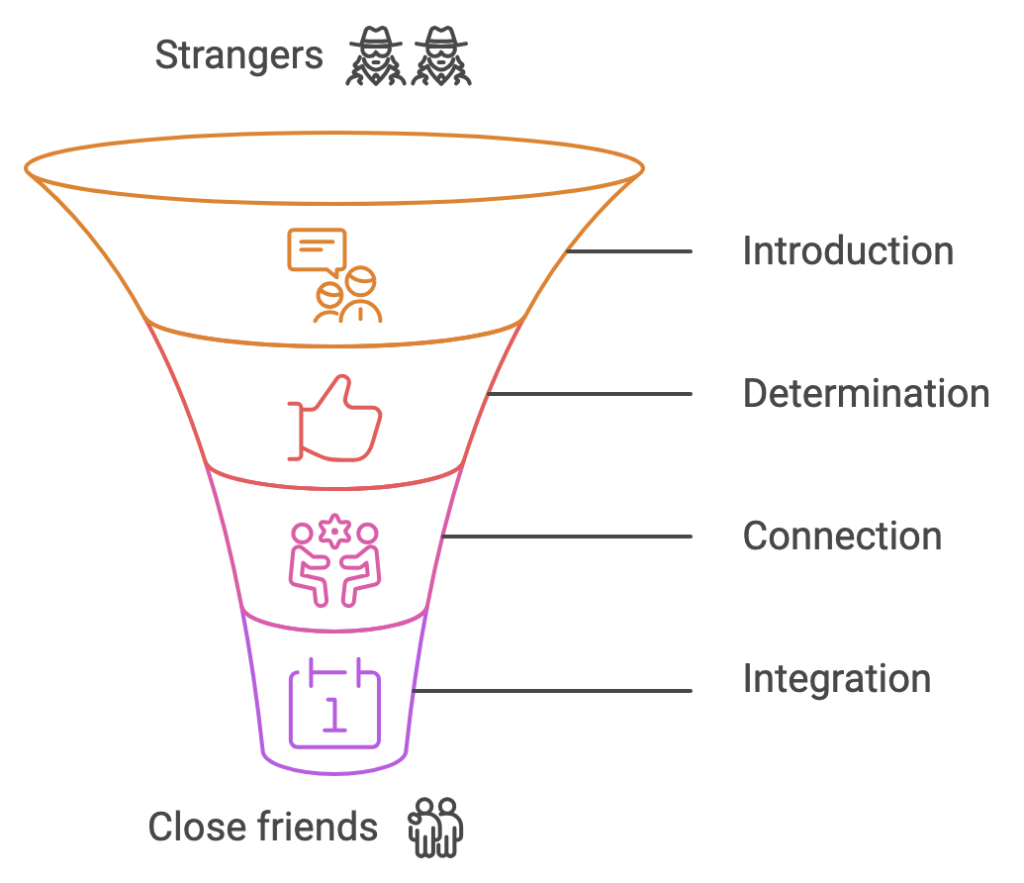
There is a universal process for two strangers to become friends. I call it a staircase, because both individuals have to put in work to get to each subsequent level. While each step will look different for every friendship, the process is generally the same:

Introduction
There are countless ways two friends can initially meet–in a class, as neighbors, at work, at a party or event, etc. Some environments are, of course, more conducive to introductions than others (good luck starting a conversation with someone on a crowded subway), so while most of us are ::around:: people every day, the opportunities to actually ::meet:: any of them are often scant.
Determination
After two people meet, they each go through a process of determining whether the other person is someone they’d like to have in their life. This process can sometimes happen in an instant (particularly if the answer is an empathic ‘No!’). On occasion we meet someone and there is just an instant ‘click.’ But in most cases, if a new person seems like a potential new friend, it often takes a while to come to a strong determination that this is a friendship we want to happen, and into which we’re willing to put real time and effort. These friendships can turn out to be just as close or closer than the friendships that start with an instant ‘click’ (one of my best friends really disliked me for the first few months we knew each other).
Connection
The connection phase of a new friendship is the longest and arguably never ends. Research suggests that it takes at least 30 hours of spending time together for two people to consider each other “casual friends,” and 140 hours to become “good friends.” In successful friendships, there is often a common place or activity that provides a built-in reason for the two to spend regular time together. We often meet people we get along with and would love to be friends with, but to deliberately schedule every get-together takes too much effort and is often where friendships die before they can even get started. (Think of how many potential friendships have ended with a text message that says, “Thanks for the invite, I can’t that day, but let’s get together soon!”)
Integration
When a friendship is established–both friends are invested in the friendship, enjoy each other’s company, and have opened up to each other–AND time together is integrated into their schedules and lives (they’re co-workers and get lunch together at least weekly, or watching [insert sport] together is what they do, or they’re tennis/sailing/basketball/gym/anything “buddies,” that is friendship on cruise control. Schedules and routines that do not include friends is one of the most significant factors contributing to people’s sense of social isolation.




2 Comments
Comments are closed.