The Backstory
A couple years ago, my wife and I were arguing. I feel a lot of antipathy towards parenting, which leads to a lot of arguments. At one point during this particular fight, she wanted to say that I needed to make friends with other dads. If I did, I’d have other men to talk to, commiserate with, and complain to, rather than trying to bottle these feelings up on my own and have them boil over at home around her and our two boys. But in the heat of the argument, what she actually said was, “You don’t even have any friends!”
“I have a lot of friends!” I shot back.
“Yeah, but every one of them is at least five hours away!” she responded.
“… Okay, that’s… accurate…” was my own meek reply.
It’s true. I feel incredibly lucky to have nine guys whom I consider my close friends. We could show up unannounced at each other’s door and be welcomed in and invited to stay. We can travel together and talk about anything. But I’m lucky to see a single one of them even once a year, because my wife was right–they all live at least five hours away by car or plane.

I realized I did need to make some friends in San Diego, but I wasn’t sure how. I actually see a lot of people on a daily basis, but as a business owner, they’re mostly employees, customers, or strangers at the coffee shop or gym. As a 30-something guy with a business and a family, where would I go, or what would I do, just to meet someone who could become a new friend?
The Problem of Social Isolation Is Everywhere
I started thinking about the problem all the time. This was 2022, when the problems of loneliness and social isolation seemed to be on everyone’s mind. COVID and the lockdowns had only accelerated trends happening for years. The number of friends we all have and the time we spend with them has been declining steadily for 30 years. These days:
- 34 million Americans are unsatisfied with the number of friends they have.
- Half of all Americans have only three or fewer close friends (someone you could share something personal with).
- One out of every five single men has zero close friends.
Each of these depressing statistics represents an enormous rise compared to 30 years ago.
What’s to blame? A number of things. Our tendency as Americans to relocate frequently for school and work. The isolating effect of smartphones, earbuds, and the omnipresent internet. The way we’ve designed our cities, towns, and workplaces around cars and distance. The decline of community places. The rise of remote work. All the small, immeasurable ways we’ve forgotten how to make connections and just hang out. We’ve inadvertently built ourselves a society in which most of us are physically close to hundreds of people every day, but know none of them.
And yet research suggests that people value friendship above all, even over love and marriage. Not having enough friends shortens our lives in the same way as smoking fifteen cigarettes a day, and increases the risk of disease, depression, anxiety, and dementia. Nearly all of us want more friends. So how can the problem be getting worse, and more importantly, why haven’t we solved this problem yet?
What I Learned Talking to Others
The decline of friendships and the rise of social isolation is The Problem, but as I talked to men and women about times they’ve felt they needed more friends and what they did about it, I started cataloging at all the little problems that make The Problem worse. A few themes emerged:
First, men in particular apparently just won’t put in effort into meeting people and making new friends, even when they know they need to. If the men I spoke with had played a sport seriously in college or high school, they told me that when they realized they needed more friends, they found a local club league to join. If they didn’t have a sport though, the men I spoke with told me they just didn’t do anything to make new friends. (The women I spoke with, on the other hand, often could recite the exact steps they took to make new friends–the classes, groups, and studios they joined; the number of times they committed to going each week; the number of conversations they committed to start each time.)
Second, there are just so many points between the moment two strangers meet and the moment they both would consider the other a “close friend” in which the awkwardness of the moment, or the mere potential for awkwardness, can cause the two simply to break contact. For example, a number of men told me similar stories about meeting another guy at a professional conference, getting along and feeling they could be friends, but then not asking for a phone number of email address because “it just felt awkward.”
Finally–and this was hardly a surprise–talking with people reiterated just how hard it is to make friends as an adult. It takes about 30 hours of time together for two people to consider each other “casual friends,” and about 140 hours to consider each other “good friends.” The sheer time and effort required to schedule that first hour let alone the 30th is often why potential friendships simply never have the chance to develop.
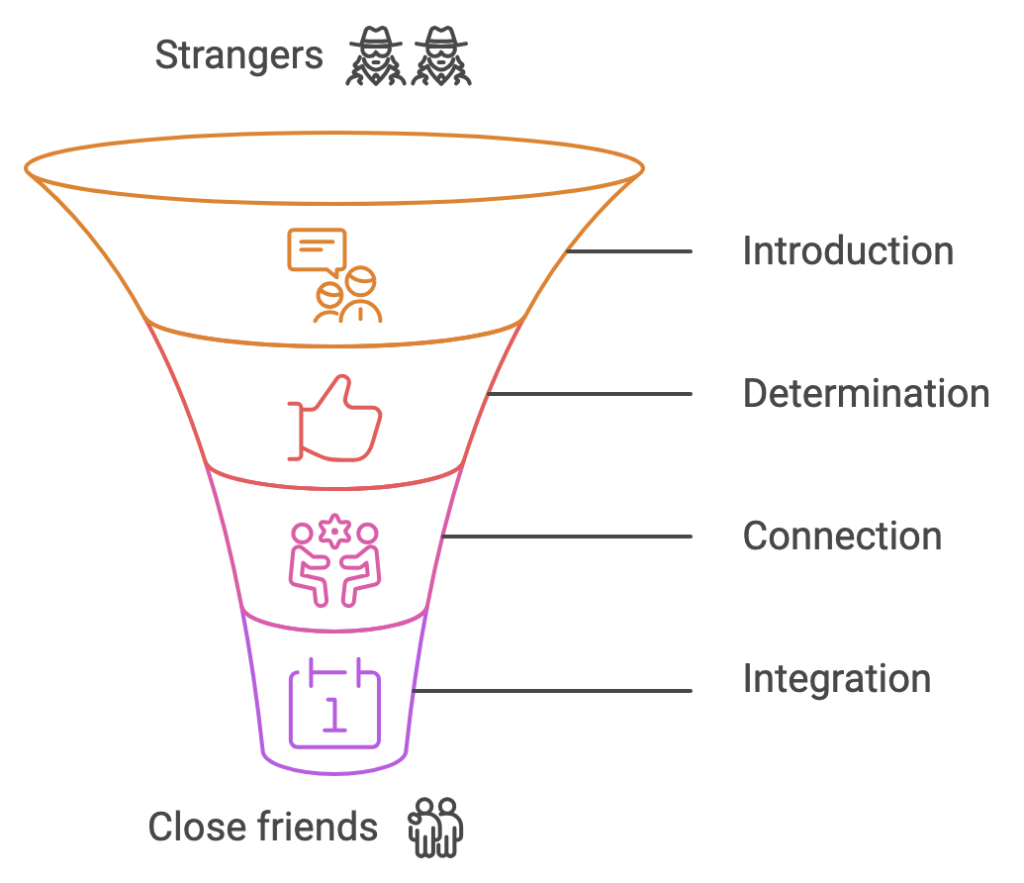
The process for two strangers to become friends is universal. I call it the Friendship Staircase, because both people have to put in work to get to each subsequent step. While each step will look different for every friendship, the process is generally the same:

Looking at Existing Friendships Apps and Noticing the Problem They Shared (Only Solving for the Bottom Step)
This challenge in meeting new people and making new friends is widespread and prominent problem, and a lot of folks have made or are making efforts to solve it with technology. Bumble has BumbleBFF, a Bumble-like app focused on friendship. There are myriad startups focused on friendship-making within specific niches (like Peanut, a friendship-making app for pregnant women and new moms). Meetup.com and local groups on Facebook, Nextdoor, and Reddit offer platforms for folks to organize real-life events around specific interests or activities.
Despite all the effort, attention, and money put into apps to do for friendship what dating apps like Tinder did for romantic relationships, nothing has yet clearly worked. One study found that 84% of Americans have never used a “friendship app” (compared to 65% who have used a dating app).
Why is this, if people really do value friendship over romantic love and marriage?
My hypothesis is that the hormone-driven motivation to find love and sex is enough to push us (men and women) past the awkwardness, friction, and pain of dating and dating apps. But the need for friendship is felt less acutely, and so the same friction and awkwardness we tolerate in dating apps is enough to stop us from using or even trying friendship apps.
Like dating apps, existing friendship apps seem focused entirely on connecting people at the top of the funnel. You don’t know where to meet people? Meet on our app, or at this dinner with five strangers, or at a weekly meetup for __. But then it remains on you to introduce yourself, make small talk, get a phone number, set up the first or second real-life hangout.
The Idea for Covalish – Inverting the Friendship Staircase into a Friendship Funnel
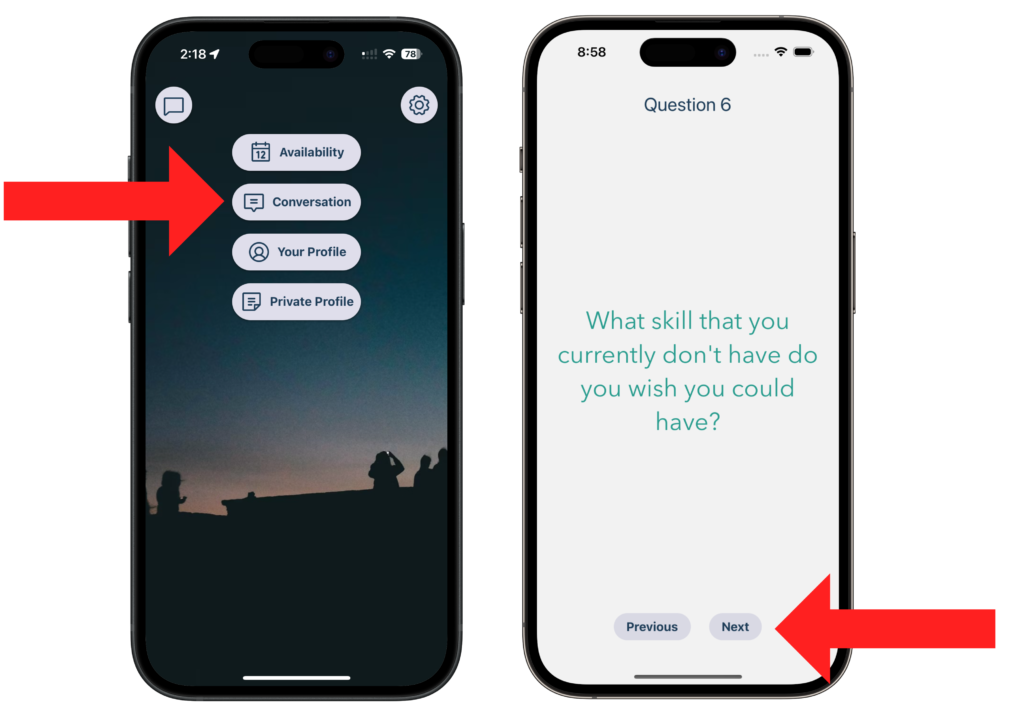
My idea for a solution formed and grew over the course of a year. It seemed to me that a technology-based solution would have to approach creating friendships in a fundamentally different way from how we’ve approached technology for dating. A working solution would have to make every step of the Friendship Staircase easier.
A truly effective solution would invert the staircase entirely. Eliminate the awkwardness. Eliminate the effort. Turn the Friendship Staircase into a Friendship Funnel, where the only effort needed is to sign up. I named my idea Covalish (a covalent bond is when atoms connect to form a molecule; friendships can feel as strong as that).
Testing and Validating the Covalish Concept
In late 2023 I started testing the idea. I spent a couple hundred dollars on social media ads with a simple message:
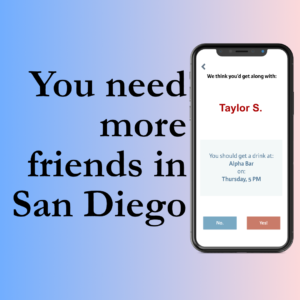
It seemed to work. A bunch of people who signed up let me know when they were available and I scheduled meetups–just show up at this place at this time, meet this person, and have a conversation around these questions. I met people, and I introduced people to other people. That worked. There were also aspects and ideas that didn’t work. I’ve used all the feedback I’ve received over the last year to build out and refine the app, which folks have been using to meet new people in central San Diego.
Launching and Growing
After a few false starts in 2024 (advertising, only to get an email that the Android app was blank, etc.), the app is now live for iOS and Android and I am in growth mode. Lacking the means to simply saturate with paid advertising, I’m working to grow Covalish in central San Diego by 1s and 2s, through real-life conversations and engaging with local folks online.